

Facilitating the TLA Way: Foundations of Facilitation
Conversation between Amanda Faye Lacson and Tracie Nichols about how "the TLAN way" informs their facilitation in the upcoming class "Foundations of Facilitation"


Q: Tracie, what do you think makes facilitating for Transformative Language Arts (or TLA) so different from facilitating for other groups?
A: Tracie During the conversation that sparked the idea for this article, Amanda, I remember paraphrasing a quote by Biomimicry author and founder, Janine Benyus where she says, “Life creates conditions conducive to life.” I paraphrased that to, “TLA creates the conditions conducive to using language to create transformation.”
In my mind, there’s a relationship between the Benyus quote and TLA because deliberately making space for language to be a catalyst to significant change, personal or communal, is creating conditions conducive to life, or at least to an improved life.
What really intrigues me about TLA is how widely it can be applied. It’s easy to see how facilitating for TLA can be applied in groups or classes where words are the primary focus—places like writing groups for people living with chronic pain or illness. And, we can create those conditions conducive to using language to invite transformation in all sorts of venues and across many professions.
For example, I recently taught a four-week workshop on sustainable marketing strategies. This could have meant simply talking about marketing and promotion techniques, but, in my experience, that approach only touches on half the equation. So, I designed and facilitated the workshop through a TLA lens. In addition to exploring marketing strategies, participants used writing prompts and exercises to uncover information about themselves and their businesses that transformed beliefs and assumptions limiting or distorting what they perceived as possible and the ways they could put their ideas into practice successfully and sustainably.
So, “facilitating for TLA” means I am intentionally creating conditions conducive to using language to catalyze transformation.
Q: What do you think, Amanda? What makes facilitating for Transformative Language Arts (or TLA) so different from facilitating for other groups?
A: Amanda For me, facilitating for TLA means that our participants are generally open to writing as a process - and if they’re not, they’re going to be! What I bring to my TLA groups is my love for being messy in writing, knowing how keeping the pen moving for oneself first, without the fear of being craft-perfect, is the goal. The reason TLA is so unique is because it focuses both on the personal transformation AND the social/community transformation, considering the relationship between both at all times.
This is why we’ve designed the Foundations of Facilitation class to take care of the facilitator first: through journaling and continually doing self-reflection. I think you can’t properly facilitate a group if you don’t reflect on what you bring to the space, what you leave out the space. Bringing your whole self to a space doesn’t mean dumping your problems on your participants OR pretending those problems don’t exist. But being in community with yourself is just as important as being in community with others. Like you said, Tracie, that’s how we can create the conditions to catalyze transformation.
Facilitating to set the ground for that community transformation means that we create spaces where we can feel held, understood, positively challenged (i.e. asked instead of lectured at). This past spring I taught playwriting and memoir in several New Jersey high schools. In the first few sessions, ground rules were key! I wanted the students to know that I wouldn’t share their stories outside of the classroom, and that their fellow students wouldn’t (hopefully) either. Writing in the rooms, some students were more reluctant to share than others (this will happen in any group), but some were encouraged and inspired to share because their fellow students did. With good ground rules, holding the space, and a good workshop structure, I felt confident as a teaching artist. I received feedback from some students who said a) my prompts helped them remember catalyzing moments that they could use to write their college essays and b) they loved coming in and writing because it felt like therapy. To me, giving students that space and time to bring their experience to words felt like I was nurturing my high school self, who was never asked to tell her own story in the classroom.
Q: Tracie, what’s a satisfying experience that you’ve had facilitating a TLA space?
A: Tracie It seems disingenuous to say that facilitating TLA spaces is always satisfying, but that really has been my experience. One space that stands out was a small group workshop I facilitated several years ago. It invited a group of six people—women and women-identifying—to notice the words they used to describe themselves and their lives. It asked them to notice how they named themselves to the world and then explore how that language, those names, affected their self-perception as well as how their community perceived them.
Like the facilitated space you made in those high school classrooms, I laid the foundation for an intentional space by 1) co-creating group guidelines with the participants 2) choosing a physical meeting space that provided privacy, accessibility, and comfort, with special attention to limiting intrusive noise 3) a workshop structure that was clear and well-organized, but also flexible enough to respond to emerging needs and questions 4) tending myself as the facilitator with pre and post-workshop self-care and, as you said above, noticing “what you bring to the space, what you leave out the space.” Nearly ten years later, participants still mention how the insights from that workshop helped them transform how they saw themselves and consequently, how they named themselves to the world. Without the solid ground of that TLA facilitated space, I’m not sure the participants would have felt steady enough to explore as deeply as they did.
Q: Amanda, I’m curious, what about facilitating TLA spaces feeds you as a facilitator?
A: Tracie For me, it’s how that touchstone of catalyzing transformation encourages such deep reflection, critical thinking, and being willing to see through the eyes of a beginner. It disrupts assumptions and unquestioned beliefs in the very best way. I find myself crafting spaces that are very co-creative and collaborative—where I am as much a co-learner as a facilitator.
Q: Amanda Ooh, good question Tracie. I would say that I am fed, when I see a person bringing a spark, thought, feeling to words that they hadn’t considered before. When something occurs to them for the very first time, and they light up (or tear up) in a way that shows a physical shift, an opening, a - transformation. It’s very much aligned with Eugene Gendlin’s Focusing, where he talks about the felt sense - and when you acknowledge and bring to words what the felt sense is all about, it’s always accompanied by a physical shift, a release or opening, rather than a tightness or compression. Having practiced focusing on and off for the past fifteen years, I know what naming the felt sense can do, and how new words can create new poetry, meaning, and growth. I know you and I both are attuned to what our bodies tell us in a space - and how grounding ourselves in our words is a key component of facilitating, staying present and staying active in TLA spaces.
Thanks for having this conversation with me, Tracie! I always love being in dialogue with you.
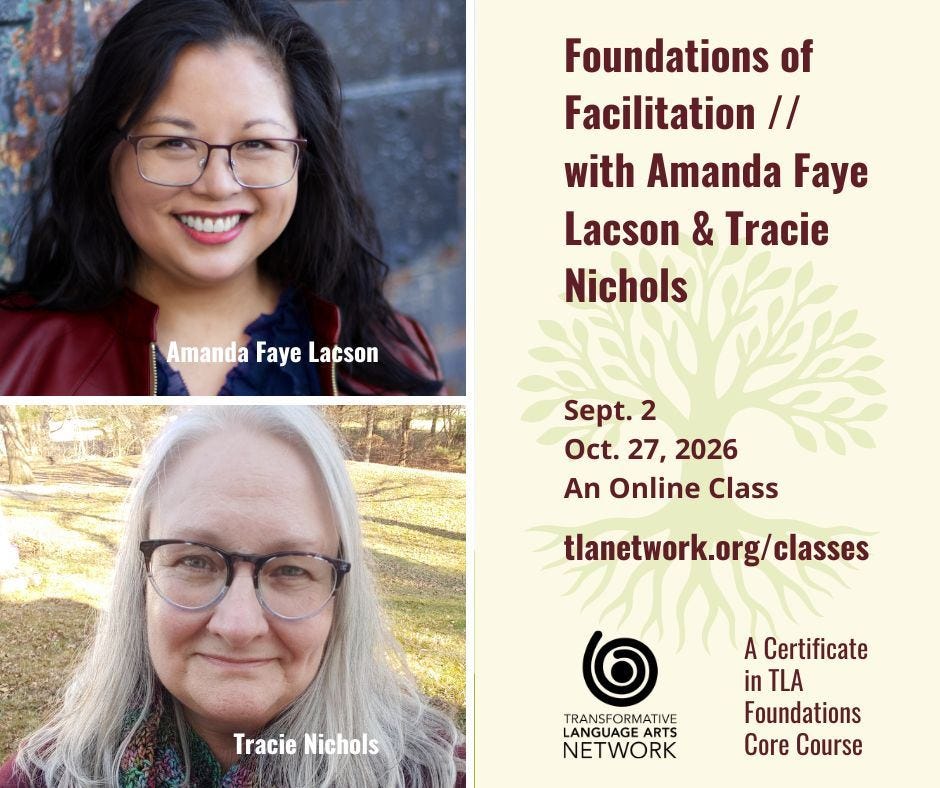
link to class registration: https://www.tlanetwork.org/event-6419845
Author bios:
Amanda Faye Lacson, MA-TLA, is a first-generation Filipina-American writer, photographer, historian and teaching artist. Her writing and community work centers on how identities are shaped, how we write our history, and how we can reexamine, engage with and disrupt limiting myths. Her playwriting has been developed with Fresh Ground Pepper, Ma-Yi, the Garden State New Play Festival, Primary Stages and Playful Substance Theater. A longtime teaching artist, Amanda teaches foundational courses in the history, practice and facilitation of Transformative Language Arts (TLA), and memoir-playwriting workshops for high schoolers with Jersey City Theater Center. As a family historian, Amanda is a founding member of Biographers Guild of Greater New York (BGGNY). Learn more at www.amandafayelacson.com.
Tracie Nichols, MA, is a poet, facilitator, and literal tree hugger honoring words and wild through poetry, writing circles, and co-creative conversations. She’s been starting things and holding yeasty, creative, growing spaces for people for 20 years. HSP, introvert, and woman of deepening years, Tracie lives and works under the wide reach of two sycamore trees in the rolling terrain of southeastern Pennsylvania. Her Substack is
 | A guest post by
|
 | A guest post by
|