

Poems (despite) (because)
or why I do this to myself over and over again


On third Wednesdays we publish Community Voices: Heartfelt essays, articles, micro-flash, poetry, songs, monologues, plays and more from TLArtists drawn from community submissions. Maybe next time it will be yours? We accept submissions on a rolling basis. Send us your words!
We invite comments, questions, conversations and restacks. If you like what you read, click the heart or share us with friends!
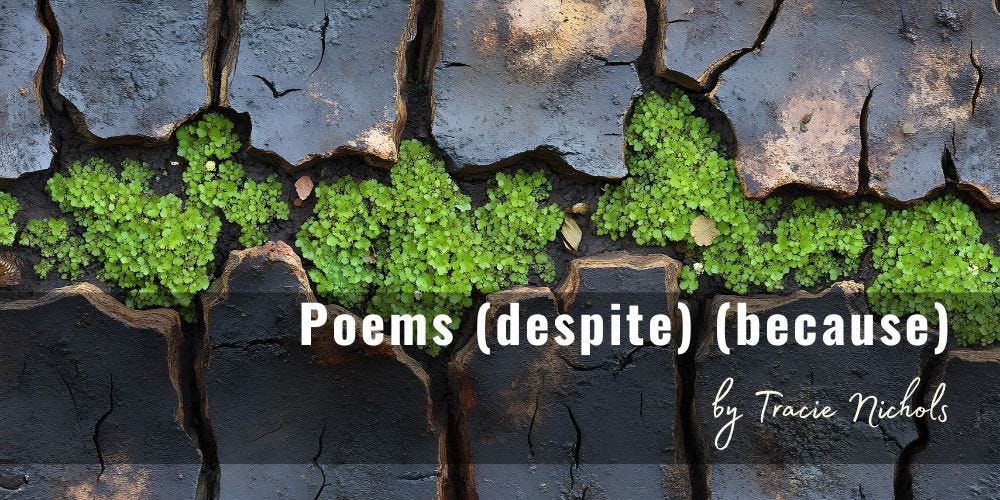
August of 2021 found me deep in the magic of “Future Casting: Writing Towards a Just World Vision” an online class offered through the Transformative Language Arts Network (TLAN) and facilitated by the astonishingly creative Caits Meissner. In the sixth and final week, Caits suggested we write a statement of poetics. For me, this was a very new and not entirely welcome idea. The following is what I wrote in response to that invitation. (Warning: this piece mentions violence and employs some salty language.)
For most of my life, whenever anyone asked me to summarize myself or my art I panicked, froze, then fled, usually leaving a comet tail of epithets. If cornered, I deflected. “Want to know me?” I’d hiss, “Go read my poems. They’re scraped from the inner walls of my ascending aorta.” Similarly, questions about my writing process often ran into a big old slammed door of “none of your damn business.”
I always thought it was because I’m an introvert with a bit of social anxiety. Lately, though, I’m coming to understand that it’s because writing poetry is how I wrote myself back into a breathing presence in my own mind and trying to codify that feels like I risk diminishing its creative, sustaining, power. Sharing my purpose and process as a poet feels x-ray intimate.
When I was a child, I was in so much pain—so deeply psychically displaced—it seemed I was only holding on to this world by a forefinger and thumb. My seventh grade art teacher tossed me a rope when he asked our class to write a poem in response to an art film of stampeding wild horses. There were foals in that snorting, screaming, rampaging mess. I recognized their terror and out-of-control turmoil. I felt it in my body and then streamed those messy, shouting word-feelings onto the pages of my tidy school notebook. And that, as they say, is where it all started.
I continued writing poetry to locate myself in myself and in the world, to imagine a place where I belonged, to make a space for myself that made sense despite nearly nothing around me doing so. The process of writing poetry—at least the way I interpreted it—let me circumvent my indoctrinated, gas-lit mind and write what my body felt, noticed, and perceived. I could write about the tall white pine tree and how I first, finally, felt real belonging when wrapped in their branches, listening to the wind.
I write because words and images live in my bones and itch.
I write so those words detach their atoms from my marrow and coalesce themselves into poems.
I write because my arms ache from holding the unflinching truth of violence in one hand and the equally unflinching truth of compassion in the other.
I write to make sense of violence: the large and small violences we impose on each other, the cuts and digs we carve into ourselves, the narrow, restrictive, suffocating norms a culture inflicts on its members, the ongoing rape of this planet.
I write to find respite in everyday moments of connection and the steady reliability of natural rhythms—small, quiet things like morning following night.
I write because my body is etched with violence and betrayal and understands how finding respite in small, everyday beauties helps survival turn the corner into living.
In the beginning, I wrote so I could know I existed. These days, I write because I hold the truth of both violence and compassion in my body and I know there are people who need to hear that is possible. I write because I have lived sixty years of life in the face of a beginning that should have ended me and there are people who need to know that’s possible, too.
I write poems to be catalysts. I offer them as seeds. I hope they plant change.
Tracie Nichols is a poet, facilitator, HSP, over-thinker, introvert, and woman of deepening years. When she’s not doing managing director things for the Transformative Language Arts Network (TLAN), she creates seasonal word adventures for shy but curious people. Tracie is honored that her poetry has so far appeared in Rogue Agent, Text Power Telling, kerning: a space for words, The Weight of Motherhood Anthology, and in the “Resistance and Resilience” exhibit at the Eclipse Center for Creative Community. She lives and writes under the reach of two gracious old sycamore trees in southeastern Pennsylvania. Keep in touch at tracienichols.com or tracienichols.substack.com.
Join us for TLAN events & classes
Check out our classes and free community events. Scholarships for classes are available.
Free Community Events
07 Dec 2025 5:00-6:30 PM (EDT) • online • Free and open to all • Performances and presentations of their work by TLAN members followed by an artist talkback. Join us!
Classes and Workshops beginning in January 2026
New Years Revolution: Writing Toward the World We Deserve // with Tasjha Dixon
07 January 2026 (CST) • Online • 8 week course
Meditate, Move, & Create // with Christina M. Rau
07 January 2026 7:00 PM • online • 90 minute workshop
Future Casting: Writing Towards a Just World Vision // with Caits Meissner
14 January 2026 • Online • 8 week course
TLA: This is How It Started. This is How It’s Going. // with Caryn Mirriam-Goldberg
17 January 2026 2:00 PM (CST) • online • 2 hour workshop
The (Extra)Ordinary Moment: The Art and Craft of Micro-Memoir // with Elizabeth Lukács Chesla
28 January 2026 • Online • 4 week course
 | A guest post by
|